
It allows users to extract and ingest data automatically, and use formulas on the data to process and transform it. In this blog, we will see what expenses are, how they are recorded, and the various types of expenses, along with an example for better understanding. We will also understand what the difference is between expenses and expenditures. Any tax that is collected by a business on behalf of the IRS, such as the income tax on the salaries of employees that is deducted at source by the employers, is not treated as an expense of the business. Repair and maintenance expenses help to keep the assets of a business in good shape.
Parts of an Income Statement
Subsequently, another journal entry is created to close the Income Summary account. The Income Summary account is debited for its balance, representing the total expenses transferred from the expense account. An expense account is used in accounting to track and categorize the various expenses incurred by a business during a specific period, such as a month, quarter, or year. It helps businesses monitor their spending and analyze where their money is allocated and spent. Anyone in a fixed assets business or organization can make expenses, but accountants and finance teams are responsible for tracking and reporting these transactions. Under the accrual accounting method, expenses are recorded when they are incurred whether payment has been made or not.
Automated Credit Scoring
Visualize the way your money moves, and move your business like an expert. Payment of dividends on ordinary share capital is not considered as an expense of the company but treated as a distribution to owners. Organizations need to insure their assets against a range of adversities, such as the outbreak of fire, earthquakes, theft, and diseases. Organizations are continually looking for ways to improve their products, processes, and understanding of customers and markets, which is why they are willing to invest substantial sums on research activities.
- Usually a person without a four-year or five-year accounting degree employed to record routine financial transactions for smaller companies.
- A temporary account used in the periodic inventory system to record the purchases of merchandise for resale.
- When inventory items are acquired or produced at varying costs, the company will need to make an assumption on how to flow the changing costs.
- Properly organizing and managing these accounts enable businesses to track and control expenses effectively, contributing to financial stability and profitability.
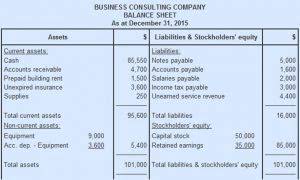
- Joe looks at the balance sheet again and answers yes, both Cash and Common Stock were affected by the transaction.
- A financial forecast tries to predict what your business will look like (financially) in the future—which is key for uncertain, economic times.
How to track your business expenses
- Interest Revenues account includes interest earned whether or not the interest was received or billed.
- This means that revenues will automatically cause an increase in Stockholders’ Equity and expenses will automatically cause a decrease in Stockholders’ Equity.
- Interest earned by a bank is considered to be part of operating revenues.
- Direct and Indirect costs can be declared on the income statement as expenditures since a personal service company does not hold inventory.
- In this method, a business knows precisely which item was sold and the exact cost.
- During the end of the accounting period, the company prepares a closing journal entry.
- Revenue minus expenses equals the total net profit of a company for a given period.
The account title for the money that Direct Delivery has a right to receive for having provided the service is Accounts Receivable (an asset account). On December 2, Direct Delivery purchases a used delivery van for $14,000 by writing a check for $14,000. The two accounts involved are Cash and Vehicles (or Delivery Equipment). When the check is written, the accounting software will automatically make the entry into these two accounts. Did the first sample transaction follow the double-entry system and affect two or more accounts? Joe looks at the balance sheet again and answers yes, both Cash and Common Stock were affected by the transaction.
- This expense is variable and directly tied to the production of goods or services.
- Accrued expenses also may make it easier for companies to plan and strategize.
- The exceptions to this rule are the accounts Sales Returns, Sales Allowances, and Sales Discounts – these accounts have debit balances because they are reductions to sales.
- With thousands of such transactions in a given year, Joe is smart to start using accounting software right from the beginning.
- By investing in these areas, Hershey aims to drive sales growth, enhance brand recognition, and streamline its internal processes.
What Are Examples of Expenses?

Consequently, expense management must be conducted judiciously, to ensure that the net effect is an actual increase in profits. Extraordinary expenses are costs incurred for large one-time events or transactions outside the firm’s regular business activity. They include laying off employees, selling land, or disposal of a significant Sales Forecasting asset.
- To understand and study direct expenses, it is important to study the company’s Trading Account.
- Additionally, it will also give you valuable insights on where you can minimize your expenses and save your budget when you need to do so.
- They may differ for different types of companies, such as manufacturing companies, construction companies, technology companies, etc.
- It is subtracted from the sales revenue to calculate the gross profit in the income statement.
- Supplies that are on hand (unused) at the balance sheet date are reported in the current asset account Supplies or Supplies on Hand.
Figure 1 illustrates how the terms expenses and losses are commonly used in practice. Indirect expenses are necessary to keep the business up and running, but they can’t be directly example of expenses in accounting related to the cost of the core revenue-generating products or services. Direct and Indirect costs can be declared on the income statement as expenditures since a personal service company does not hold inventory. Direct expenses are shown on the debit side of a trading account because costs related to the production, procurement, buying and selling of goods/services should appear in this account.
